

National Education Policy (NEP) is India’s transformative education framework, introduced in 2020 to replace the policy of 1986. Key initiatives and terms under the NEP include significant structural and regulatory changes across school and higher education.
Important Terms and Full Forms under NEP
Here are some of the important terms and their full forms associated with the National Education Policy:
| Term | Full Form | Description |
| NEP | National Education Policy | The overarching policy document aiming to reform the Indian education system. |
| ECCE | Early Childhood Care and Education | Focuses on the foundational learning for children in the age group of 3 to 8 years. |
| FLN | Foundational Literacy and Numeracy | A national mission to ensure universal basic reading, writing, and numerical skills for all students by Grade 3 by 2025. |
| NCERT | National Council of Educational Research and Training | The autonomous organization that will develop curricular frameworks for school education. |
| NCTE | National Council for Teacher Education | The regulatory body responsible for developing the National Curriculum Framework for Teacher Education (NCFTE) and National Professional Standards for Teachers (NPST). |
| PARAKH | Performance Assessment, Review, and Analysis of Knowledge for Holistic Development | The new National Assessment Centre and standard-setting body for student assessments. |
| HECI | Higher Education Commission of India | A single, overarching umbrella body for the entire higher education sector, excluding medical and legal education. |
| HEGC | Higher Education Grants Council | One of the four verticals of HECI, responsible for funding and financing higher education institutions (replaces the UGC). |
| NHERC | National Higher Education Regulatory Council | The vertical of HECI for regulation of higher education institutions. |
| NAC | National Accreditation Council | The “meta-accrediting body” and a vertical of HECI for accreditation. |
| GEC | General Education Council | The vertical of HECI responsible for setting standards and the National Higher Education Qualification Framework (NHEQF). |
| ABC | Academic Bank of Credits | A digital storehouse for academic credits earned from various Higher Education Institutions (HEIs) to facilitate credit transfer and multiple entry/exit options. |
| MERUs | Multidisciplinary Education and Research Universities | Model public universities for holistic, multidisciplinary education at par with IITs and IIMs. |
| NETF | National Educational Technology Forum | An autonomous body to provide a platform for the free exchange of ideas and use of technology in education. |
| GER | Gross Enrolment Ratio | A key target of the NEP to achieve 100% in school education by 2030 and 50% in higher education by 2035. |
| SDG | Sustainable Development Goal | The NEP is aligned with the UN’s SDG 4, which aims for inclusive and equitable quality education for all by 2030. |
| MHRD | Ministry of Human Resource Development | Renamed to the Ministry of Education (MoE) under the NEP 2020. |
New Structural Framework of NEP 2020
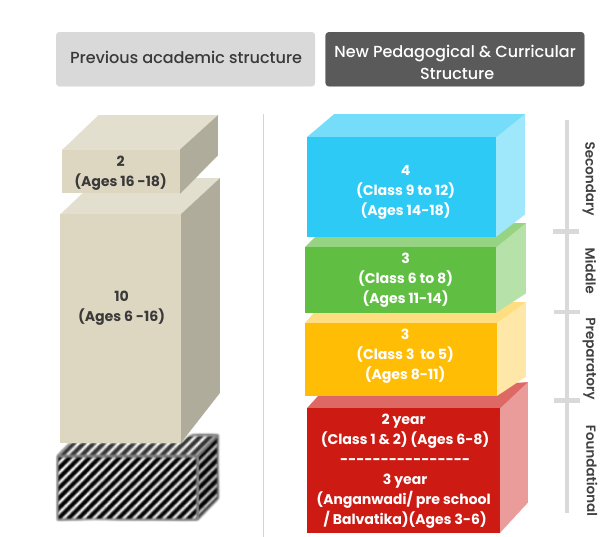
The policy replaces the traditional 10+2 curricular structure with a new 5+3+3+4 curricular structure corresponding to specific age groups:
- Foundational Stage (5 years): Ages 3-8 (3 years of Anganwadi/pre-school + Grades 1-2).
- Preparatory Stage (3 years): Ages 8-11 (Grades 3-5).
- Middle Stage (3 years): Ages 11-14 (Grades 6-8).
- Secondary Stage (4 years): Ages 14-18 (Grades 9-12).
FAQs on National Education Policy (NEP) 2020
For further details, refer to the following resources:
For more information and in-depth understanding, please visit the links below:
[1] https://leadschool.in/school-owner/national-education-policy-nep-2020/
[2] https://testbook.com/question-answer/full-form-of-n-e-p-2020-is–68834625e5624ed7cbd08fdd
[3] https://www.eoiprague.gov.in/page/new-education-policy-2020/
[4] https://vajiramandravi.com/upsc-exam/national-education-policy-2020/
[5] https://www.ampersandgroup.in/blog/national-education-policy-(nep):-advantages-and-disadvantages
[6] https://en.vikaspedia.in/viewcontent/education/policies-and-schemes/national-education-policy-2020
[7] https://www.drishtiias.com/daily-news-analysis/national-education-policy-2020
[8] https://en.wikipedia.org/wiki/National_Education_Policy_2020
[9] https://www.education.gov.in/sites/upload_files/mhrd/files/NEP_Final_English_0.pdf
[10] https://www.idreameducation.org/blog/national-education-policy-nep/
[11] https://sageuniversity.edu.in/blogs/understanding-new-education-policy-nep-of-india
[12] https://www.iitms.co.in/blog/new-academic-structure-5-3-3-4-education-system.html
[13] https://www.acadecraft.com/blog/5-3-3-4-education-system-nep-2020/
[14] https://www.cmis.ac.in/foundation-stage/national-curriculum-framework/

